
How to Check for a Warrant in San Miguel County
San Miguel County posts no official name-search warrant portal, so a warrant check starts with the facts of the case. Gather the full legal name, date of birth, former names, citation or case number, expected hearing date, and the town where the issue arose. For a state case, search the Colorado Judicial docket. That finds hearings, but it does not prove warrant status. Work the chain from there.
- Use the case number when available; otherwise search by name and court filters.
- Ask the Combined Courts Clerk whether a District or County Court order is active.
- Contact the town clerk for a municipal citation or missed local setting.
- Call Sheriff/Jail for county custody, service, and bond routing.
- Request the underlying record if verbal confirmation is not enough.
After any San Miguel County court action, ask for a receipt or next-date notice, and ask when agency records update.
No San Miguel County Warrant Portal
The Sheriff's official quick links cover inmates, records, activity, tickets, and public information, but no active-warrant search. Colorado also runs no official public statewide warrant database. The Colorado Bureau of Investigation sells arrest-history checks, which are not a warrant-clearance product. Those gaps leave the local court and agency chain as the only real route in San Miguel County.
Quick answer: A missing docket or activity entry never substitutes for current confirmation from the issuing court.
For custody, booking, bond, and county service routing, call the Sheriff/Jail line at 970-728-1911. The Combined Courts Clerk sits at 970-369-3310 and SanMiguelClerk@judicial.state.co.us. Sheriff Records answers at 970-728-4442 and records@sanmiguelsheriff.org. A phone call will not sweep every possible warrant, so ask which court or agency owns the San Miguel County matter.
Types of Warrants in San Miguel County
Jurisdiction and trigger define each San Miguel County order. District Court takes felony, family, juvenile, and other general-jurisdiction matters. County Court covers state misdemeanors, petty offenses, and traffic cases. Municipal courts handle town-code, parking, citation, and local traffic matters. One person can face more than one label, so ask the clerk to name the exact order.
| Type | Usual basis | Issuing level |
|---|---|---|
| Arrest warrant | Probable cause tied to an offense | Judge or magistrate |
| Bench warrant | Missed appearance or court duty | Court handling the case |
| Failure to appear | Missed required date or summons | State or municipal court |
| OJW | Outstanding judgment or collection hold | Colorado court |
| Search warrant | Probable-cause request to search | Judge of a court of record |
| Municipal process | Town code, parking, or citation matter | Municipal court |
San Miguel County sources use the terms bench warrant, failure to appear, warrant, and Outstanding Judgment Warrant. Texas-style capias pro fine language does not appear here.
San Miguel County Dockets Find Hearings
The state docket search takes a wide set of filters: judicial district, county, courthouse, court type, division, date, case-number components, party name, business name, attorney name, and attorney bar number. You must supply at least one filter beyond date. Results can show hearing time, duration, case number, hearing type, location, appearance type, and courtroom. Export and printable controls help you preserve what you find. What the docket lacks is any universal active-warrant, cleared-warrant, OJW, bond, or warrant-type field. A future hearing can sit on the calendar beside an unresolved order, and an old result may predate a recall. A town citation may never reach the state docket at all. So use the docket to find the court and case number, then ask the San Miguel County clerk for current status and the next required act. That habit keeps a schedule page from being mistaken for an active-warrant list.
What a San Miguel County Warrant Record Shows
San Miguel County publishes no standard warrant-number pattern and no public status-code guide. A confirmed record may still carry real detail. It can identify the court case, division, order type, issue date, judge or magistrate, reason for the order, charge or citation class, bond or hold, service agency, and any later return or clearance. Verify each field with the office that keeps it.
- Case authority
- Issuing court, division, judge or magistrate
- Order details
- Type, issue date, and probable-cause or missed-appearance basis
- Classification
- Felony, misdemeanor, petty offense, traffic, ordinance, or family matter
- Bond or hold
- Amount and type if set, cash-only term, or OJW restriction
- Status
- Active, served, returned, recalled, quashed, paid, or cleared
- Access limits
- Sealed, juvenile, investigation, and protected-data markers
In San Miguel County records, "recalled" or "quashed" means withdrawn or set aside, and "served" concerns execution. Confirm "cleared" with a fresh court entry or order.
Request San Miguel County Sheriff Records
Sheriff Administration is the formal channel for agency-held criminal justice records in San Miguel County. The preferred Criminal Justice Record Request route uses a secure Cognito form. It asks for contact details, your relationship to the record, report number if known, incident date, involved-person information, record type, a signature, and state-issued identification. A signed C.R.S. § 24-72-305.5 pecuniary statement is required too. Remember, the request may yield a record, not a warrant recall. The official request page documents the CCJRA process and the contact line.
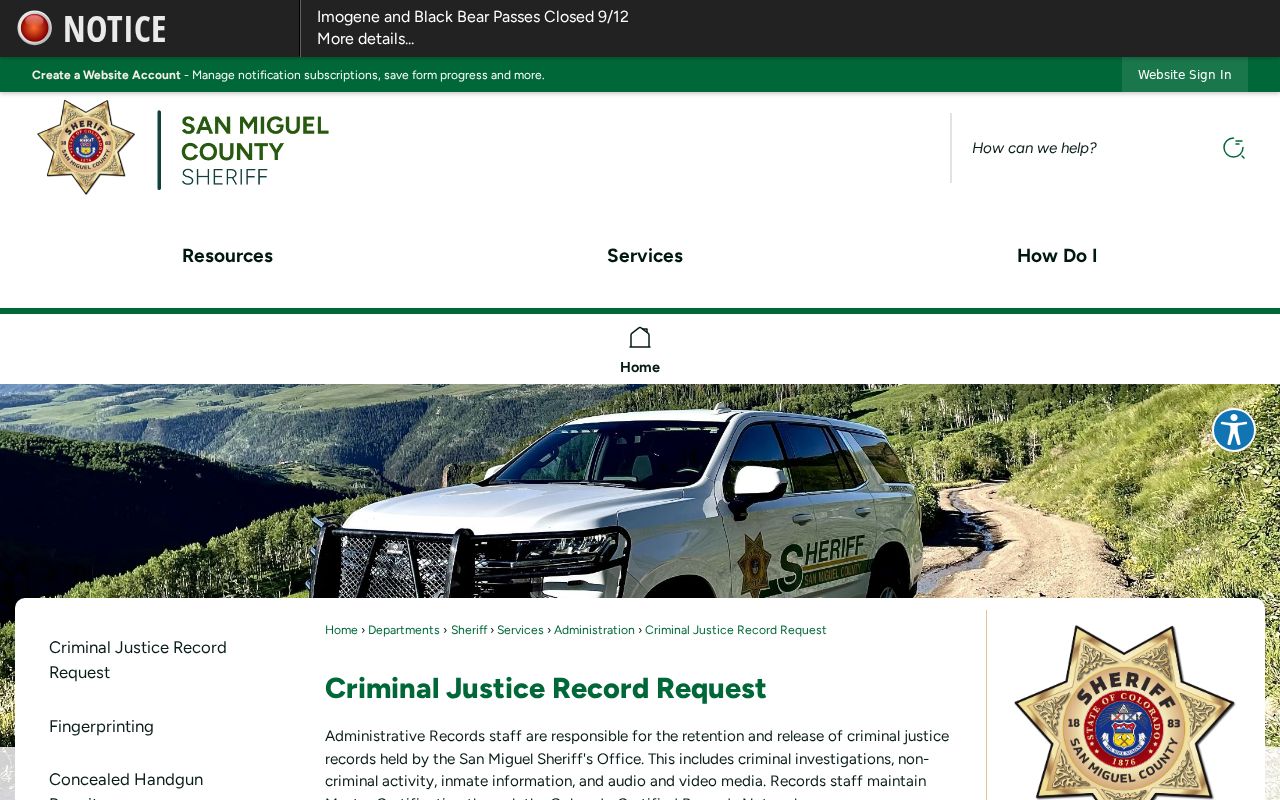
The process turns on identification, review, and direct contact, not instant warrant results. Basic electronic reports are free when processing takes one hour or less. Published charges include $33.38 per hour for audio or video research after the first hour, $5 for the first 15 physical pages plus $0.25 per added page, and $20 for a flash drive. Estimates over $30 are prepaid. Confirm current fees with San Miguel County before requesting.
Who Issues and Serves San Miguel County Warrants
A judge or magistrate issues a San Miguel County warrant, the clerk records the order, and a peace officer serves it. Which court issues depends on the case, and the place of arrest does not always point to the issuing court. A San Miguel deputy may arrest someone on another county's process.
| Office | Role | Typical matter |
|---|---|---|
| Seventh Judicial District Court | Issues and controls court orders | Felony, family, juvenile, district cases |
| San Miguel County Court | Issues and controls court orders | Misdemeanor, petty offense, state traffic |
| Municipal courts | Issue and resolve town process | Town code, parking, local citations |
| Combined Courts Clerk | Keeps District and County Court files | Status, filings, settings, records |
| San Miguel Sheriff | Serves process and operates jail | County arrest, custody, bond |
| Town marshal or police | Serves local process | Municipal enforcement |
The elected County Clerk and Recorder is not the Clerk of Court. Send warrant-file questions to the Combined Courts Clerk in San Miguel County.
San Miguel Activity Reports Are Not Warrants
The San Miguel County Sheriff's Office puts out several regular products: a current-inmate list, booking summaries, media summaries, and activity reports. Each serves a different purpose. The inmate list shows who was in custody when it was generated. Booking material covers arrests and published bond amounts. Activity reports log calls and enforcement events. A warrant arrest can surface in any of them. None is a complete list of unresolved San Miguel County warrants. Read each product for what it actually is. A custody snapshot omits people who are not jailed, and it can include someone held for another agency. Booking pages record an arrest event rather than every unserved order. Media and activity summaries do show deputies making warrant arrests during traffic stops and other ordinary contacts, including arrests on out-of-county process. Those entries cover only the reporting period. They do not establish the present status of every court order in San Miguel County. Match any useful entry to its issuing jurisdiction, then confirm with that court. The official activity page itself warns that reports are preliminary and that some information may be withheld. It presents report categories rather than a person-centered roster, and you can view the source directly.
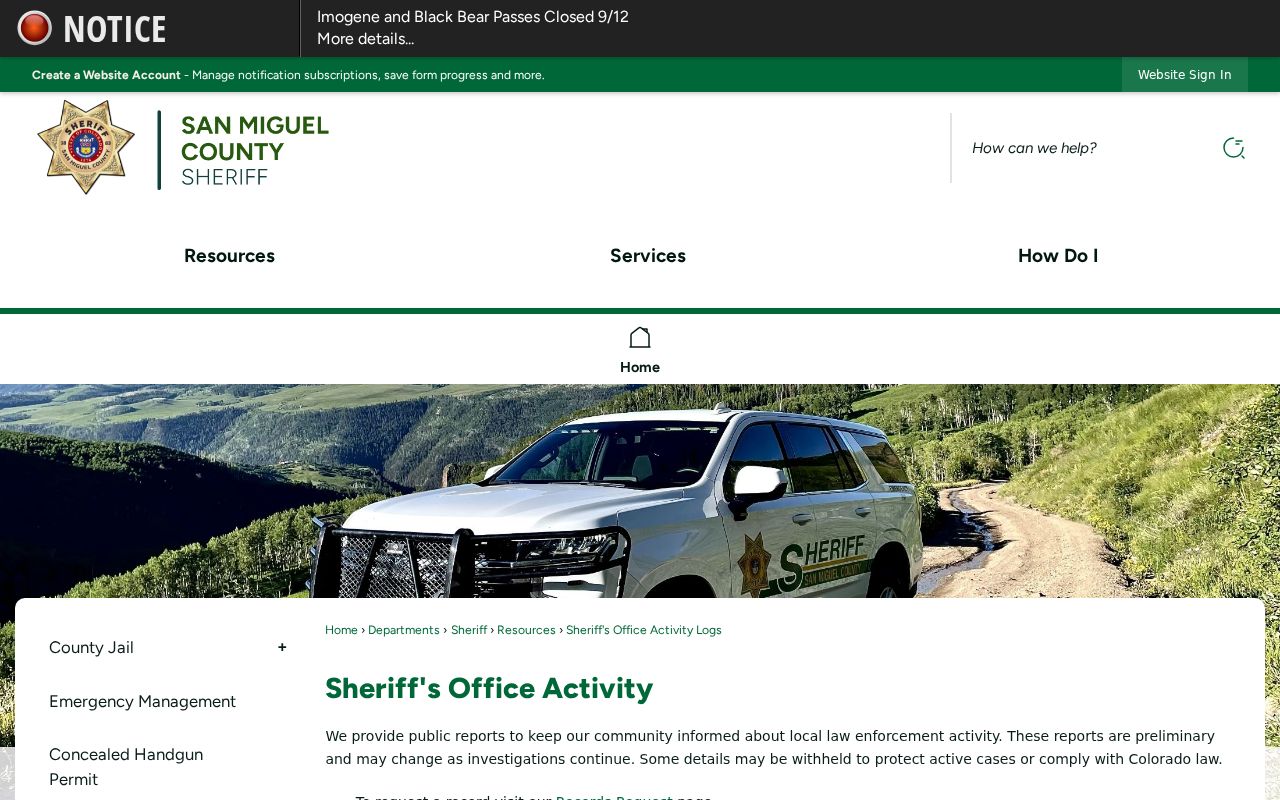
The activity reports give useful context around San Miguel County calls and enforcement, but they are not warrant records. Only the issuing court can confirm a warrant's current status.
What to Do If You Have a San Miguel County Warrant
Find out which court issued the order and what kind of order it is before anything else. Gather the case or citation number, full name, date of birth, and the date that was missed. If the clerk says the matter is an OJW or a warrant, skip the normal online payment link. San Miguel Combined Courts and the Seventh Judicial District Collections unit both say a person under such an order must come to court in person. Before you go, ask the clerk what the next step looks like: a motion, a new setting, a personal appearance, payment at the courthouse, or a bond.
- Confirm the order through the court that issued it.
- Ask an attorney about recall, quash, surrender, and bond choices.
- Arrange the location and time before appearing voluntarily.
- Use Sheriff/Jail instructions if custody or bond is involved.
- Complete the underlying court duty and obtain written proof.
- Confirm the court and Sheriff records were updated.
Caution: San Miguel County publishes no guaranteed walk-through surrender window, so coordinate with the court or counsel before arriving.
San Miguel County OJW Payment Rule
OJW stands for Outstanding Judgment Warrant. It is a label used by Colorado courts and collections, not a separate statewide warrant portal. An OJW usually grows out of an unpaid judgment or an unresolved payment duty. San Miguel County's court pages post no flat amount, no local status code, and no automatic waiver. Ask the clerk directly whether your record is an OJW, a bench warrant, or some other hold. Once the court marks an OJW or warrant, ordinary online payment stops being an option. The person must come to court. That does not mean walking in blind is smart. Confirm the case number, what payment or appearance the court wants, where to show up, and whether bond is a risk first. The Seventh Judicial District offers collection and payment-plan information, but only the issuing court can say what step resolves your specific order. Keep every receipt, and ask when the warrant and the agency records should reflect the change.
Public Access to San Miguel County Warrant Records
In Colorado, the rules split by record type. The Colorado Criminal Justice Records Act, C.R.S. §§ 24-72-301 through 309, covers Sheriff criminal justice records in San Miguel County. The Colorado Open Records Act handles general public records, and court records follow judicial access rules. The official Colorado statutes carry the current text.
- Criminal justice custodians weigh public access, privacy, and legal restrictions.
- The Sheriff requires identification and a signed pecuniary statement.
- Juvenile identifying information receives special statutory protection.
- Sealed and active-investigation material may not be public.
- A court order or rule can restrict inspection.
A record being withheld proves nothing either way. A public gap does not mean no warrant exists. Use San Miguel County records routes to check your own matter, help a relative, or learn the process, then confirm current status with the originating court.
Secure San Miguel County Warrant Requests
The blank secure form shows how much detail San Miguel County records staff expect. It keeps requester details separate from incident facts and requested media. It collects an acknowledgment and identity proof too. A case number, an incident date, and a narrow description of the record you want can cut down avoidable follow-up. The form is a formal request, not a live warrant lookup. View the source for the blank form image.
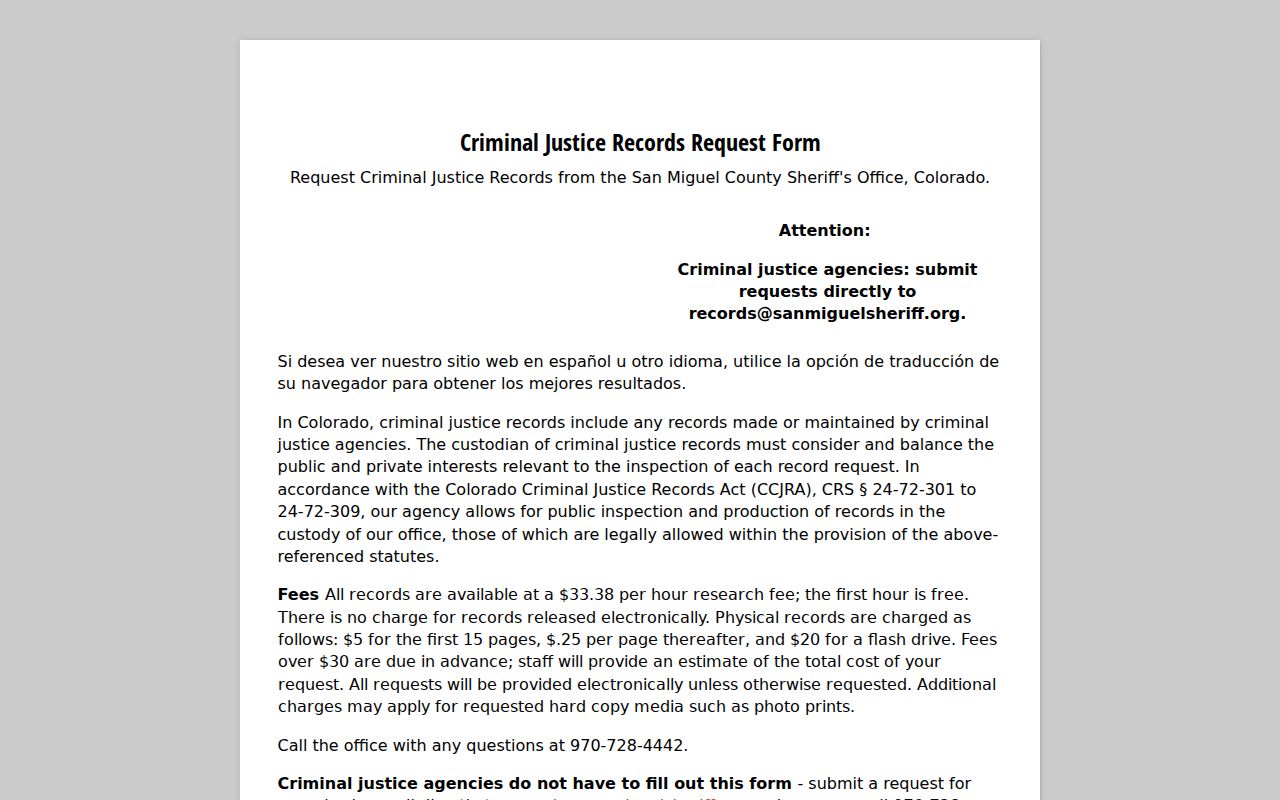
The fields support a formal records request and later delivery. They do not offer confirmation, payment, surrender, or court clearance. Records normally arrive by email unless you arrange another method. The printable route lists records@sanmiguelsheriff.org and a records-specific fax of 970-728-9206. The general Sheriff fax number differs, so confirm the right destination before sending anything. San Miguel County's broader policy describes a normal three-working-day expectation with a possible statutory extension, but that timing cannot be promised for every CCJRA file.
Warrant Records by City in San Miguel County
The Census list counts five incorporated towns in San Miguel County. Each town handles its own route. Town courts keep ordinance and citation matters, while state misdemeanors, traffic cases, and felonies go to the Combined Courts. None of the five towns posts a public name-search warrant portal.
Telluride Warrant Records
Telluride Municipal Court handles town citations. Its clerk is at Town Hall, while hearings are held at the county courthouse.
Mountain Village Warrant Records
Police records begin at the Municipal Building. Town Hall routes current Municipal Court questions.
Norwood Warrant Records
Norwood posts first-Wednesday municipal dockets when citations exist; Town Hall confirms local process.
Ophir Warrant Records
An official ordinance creates a municipal court of record, but no current warrant search or direct clerk line was found.
Sawpit Warrant Records
No verified town warrant desk was located. Start with the town route, Combined Courts, or Sheriff according to jurisdiction.
The city cards follow population order: Telluride, Mountain Village, Norwood, Ophir, and Sawpit.
Confirm San Miguel County Warrant Clearance
Money changing hands is not the finish line. Ask the San Miguel County court for written proof. A receipt, a written order, or a next-setting notice all work, and each shows where things stand. Then ask when the court's system and any Sheriff-held record will reflect the change. No fixed update interval exists. So keep the proof and verify again later. If you are arrested, bond may be posted at the Sheriff's Office at any time. Published methods include cash, money order, credit card, and cashier's check made out to the court. A licensed bondsman works too, unless the court set cash-only bond. Bond secures release and appearance. It does not end the underlying case by itself. For felony, family, sealed, or outside-county process, a lawyer can reach the issuing court and help plan the appearance or motion. One office cannot clear another court's order, and municipal matters return to the town court while County and District Court matters go back to the Combined Courts in San Miguel County.